AI has moved fast from experimentation to implementation. But many organizations are still struggling with a more fundamental question: are these tools actually making companies more innovative, or simply faster at doing the same work?
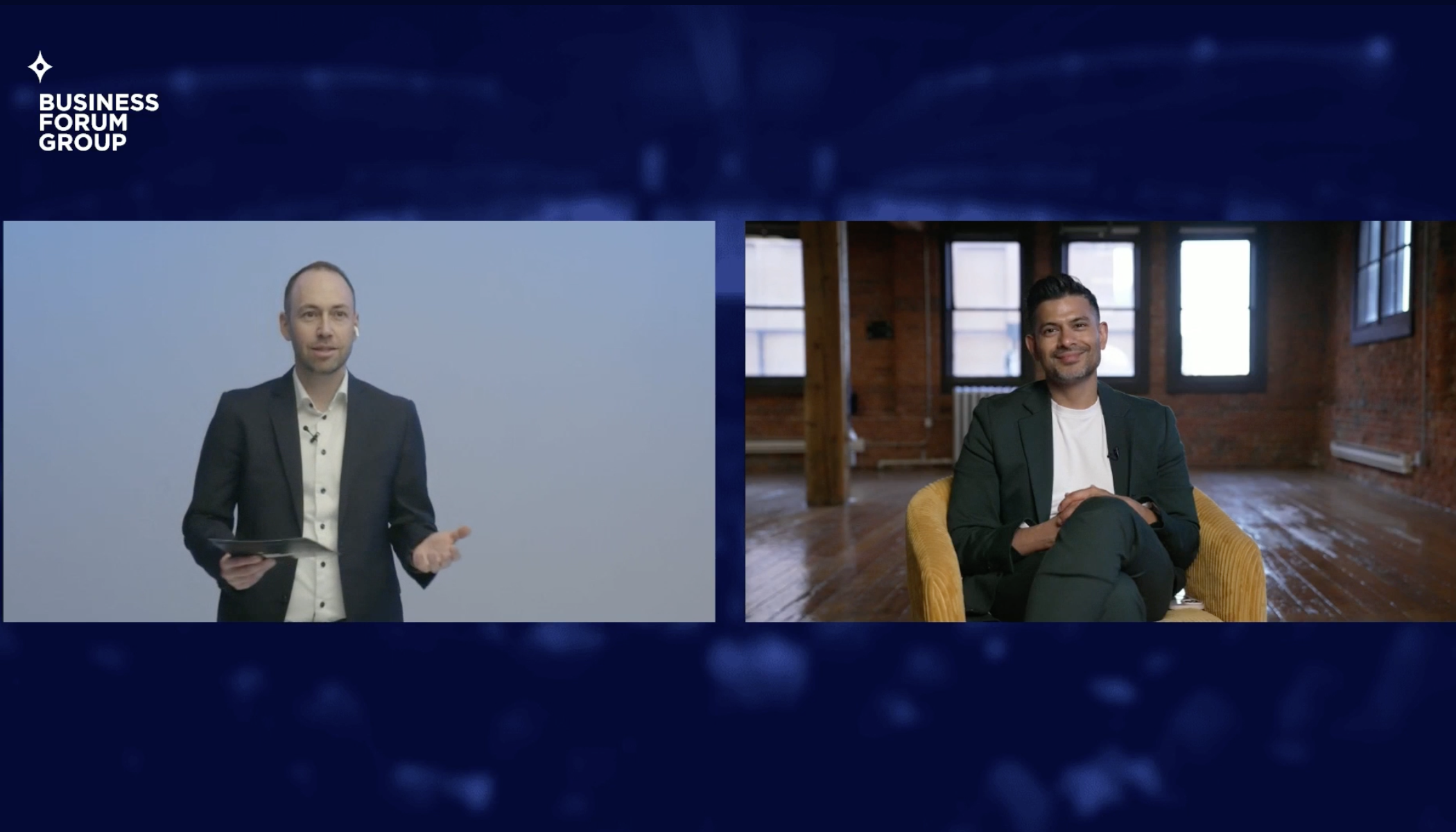
That question shaped a webinar we hosted together with Nordic Business Forum, featuring Shawn Kanungo, innovation strategist and bestselling author, alongside Shane McArdle, CEO and President of Kongsberg Digital. Together, they explored the risks leaders face when AI adoption is driven by speed alone, and why the future will belong to organizations that combine technology with human creativity, judgment, and courage.
Shane McArdle: You can’t put intelligence on top of chaos
Shane McArdle opened the webinar with a practical perspective from industries where mistakes carry serious consequences. Working with sectors like energy, oil and gas, manufacturing, and utilities, he explained that AI implementation in safety-critical environments requires a very different mindset.
“You can't put intelligence on top of chaos.”
For Shane, one of the biggest mistakes organizations make is rushing into AI without first understanding how their operations actually work. Many companies have ambitious AI goals, but the underlying workflows, processes, and knowledge are often fragmented, undocumented, or hidden inside teams.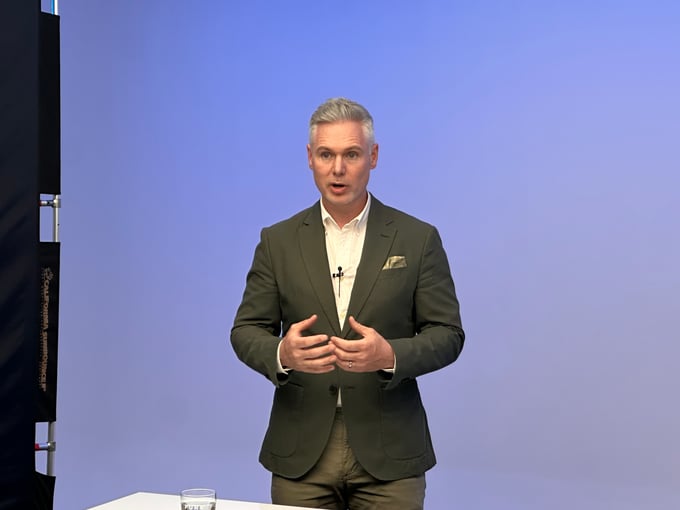
Shane McArdle, President and CEO of Kongsberg Digital AS
A large part of operational knowledge still lives in people’s heads. It may exist in siloed systems, old support tickets, or conversations that were never documented. AI cannot reason across information that does not exist.
This is why Shane encouraged leaders to return to the basics before scaling AI initiatives. He highlighted three key questions organizations need to answer:
1. What business problem are we actually trying to solve?
2. What quality data do we have available?
3. Do we truly understand how work gets done inside the organization?
Without clarity on these foundations, AI projects struggle to scale.
Shane also emphasized the importance of trust and leadership curiosity. In his view, the best leaders are the ones actively experimenting with AI themselves. Leaders need enough understanding of the technology to guide teams through change responsibly and creatively.
At the same time, organizations need what Shane called “organizational courage.” While AI is often discussed as something futuristic and exciting, much of the real work is unglamorous. It involves documenting processes, structuring data, cleaning systems, and redesigning workflows.
That practical work may not feel innovative, but it creates the foundation that allows AI to deliver real value at scale.
Shawn Kanungo: AI is making us efficient, but is it making us better?
Shawn Kanungo built on Shane’s perspective by addressing a broader challenge many organizations are now facing. AI is dramatically improving efficiency, but efficiency alone doesn’t create innovation.
Firstly, Shawn outlined that still many organizations are implementing AI way too slow and the need to speed up. On the other hand, he mentioned that the companies that are moving quicker focus on speed, optimization, and automation. Tasks are completed faster, outputs increase, and workflows become more streamlined. On the surface, this feels like progress.
But Shawn challenged leaders to think more critically about what may be getting lost in the process.
The danger, according to Shawn, is that organizations become so focused on optimization that they stop questioning assumptions, experimenting with new ideas, or developing original thinking. This new setting should make leaders rethink how their organizations currently operate and how they can use AI to create more value. Diving into those questions can be very uncomfortable, but it’s necessary.
“Being comfortable is the most dangerous spot to be in today.”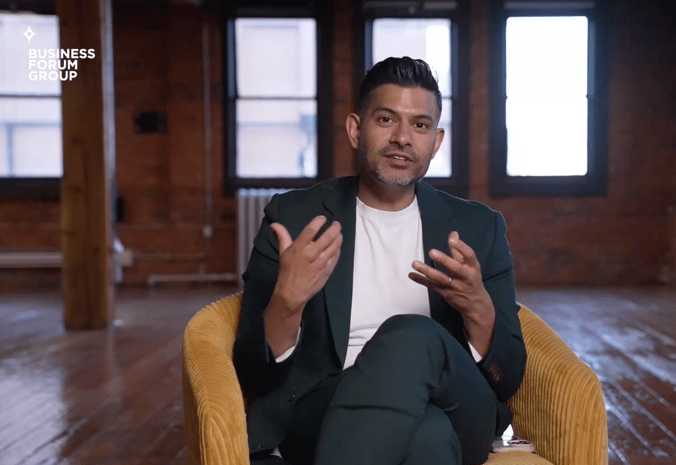 Shawn Kanungo, AI authority and bestselling author of "The Bold Ones".
AI is not a tool. It’s a new operating model
One of Shawn’s strongest arguments was that many organizations are making the same mistake with AI that they made during previous digital transformations. Leaders often approach AI as another software implementation: buy licenses, deploy tools, and expect employees to adapt.
But AI is fundamentally different. “This is not a tool. This is not a piece of software. It’s like having the most capable, the most intelligent teammate beside you.”
According to Shawn, the real opportunity is not simply using AI to work faster. The opportunity lies in reimagining how work is done altogether. Organizations should not just optimize existing processes. They should question whether some processes are even necessary anymore.
“The way that you run a process today from zero to 100 - you might not need steps 40 to 70 because of AI.”
This requires a different mindset. Instead of implementing AI politely and cautiously, Shawn believes leaders should aggressively experiment with how AI can reshape their organizations.
Efficiency is not the same as innovation
A central theme throughout the discussion was the growing confusion between efficiency and innovation.
AI is exceptionally good at improving efficiency. It helps organizations write faster emails, generate reports more quickly, automate workflows, and optimize existing tasks. But Shawn warned that this should not be mistaken for true innovation.
“Efficiency is really about optimizing the past. Innovation is about creating a new way of doing things.”
To illustrate this, Shawn used the example of the Wright brothers. If they had relied solely on existing data and accepted conventional wisdom, they might never have pursued flight at all. Innovation often requires moving beyond what current evidence suggests is possible.
By design, AI is trained on historical data. It excels at recognizing patterns from the past. But breakthrough innovation often comes from challenging those patterns, not reinforcing them. This is why Shawn believes boldness is becoming more valuable than knowledge itself.
Why boldness matters more than knowledge
Probably one of the most provocative ideas from Shawn was his claim that “knowledge is no longer power.” His argument was not that expertise no longer matters, but that access to knowledge is no longer scarce. Today, anyone has access to incredibly powerful AI systems capable of generating insights, summaries, ideas, and analysis instantly.
“I don’t need another smart person. I have four in my pocket: Grok, Gemini, ChatGPT, and Claude.”
What organizations increasingly need are people who are willing to challenge assumptions, experiment, and move forward despite uncertainty.
“The most dangerous person in the room is the person who is most afraid, yet bold enough to move forward.”
Shawn argued that disruptive ideas almost always look unreasonable at first. Throughout history, the biggest innovations were initially dismissed as unrealistic, dangerous, or even ridiculous.
“Disruption always starts as a joke until the joke is really on us.”
The hidden risk: AI could weaken decision-making
Despite his optimism about AI, Shawn also shared a significant concern: decision quality may actually decline if organizations become overly dependent on AI-generated answers.
One reason is that people naturally assume AI is correct because it has been trained on vast amounts of information. But leadership decisions are not made purely from historical data. They also require judgment, intuition, and the ability to anticipate a future that does not yet exist.
“No AI on the planet is going to be able to predict what the future is really going to look like.”
Another issue is that AI removes much of the struggle involved in problem-solving. Shawn believes this struggle is essential for deep learning and strong decision-making. When answers become instant, people may stop wrestling deeply with problems. And according to Shawn, that deep understanding is often where the best opportunities and innovations emerge.
The future will belong to two types of companies
Shawn also shared a compelling vision for how AI will reshape business models in the coming years. In his view, successful companies will move toward one of two extremes.
The first category will focus on speed, automation, and frictionless experiences. These are companies that optimize convenience and efficiency at scale.
The second category will focus on human experience, craftsmanship, trust, and relationships. These companies will intentionally slow things down to create more meaningful interactions.
“There’ll be organizations that are incredibly fast and frictionless… and then there’ll be companies that actually slow things down. It’s about experience and moments.”
The companies that will struggle, according to Shawn, are in the middle ground: organizations that are neither exceptionally efficient nor meaningfully human.
“The middle is what I call the black hole of mediocrity.”
This creates an important strategic challenge for leaders. Organizations must decide where they want to compete and ensure they are exceptional in that position.
Building a culture that can experiment
As organizations race to adopt AI, Shawn emphasized that culture will ultimately determine success more than technology itself. He highlighted three key ingredients for building an innovative AI culture:
- Deeply caring about people and creating psychological safety
- Encouraging experimentation and accepting failure as part of learning
- Establishing governance and guardrails to ensure responsible innovation
“The best organizations don’t punish people for trying something new. They ask: what did you learn?”
This balance between experimentation and responsibility is becoming increasingly important as AI adoption accelerates across industries.
A new leadership mindset
Toward the end of the conversation, Shawn offered a thought experiment that captures the scale of change leaders are facing.
“If I gave you 100 MBAs from Harvard right now, what would you do with them?”
His point was that organizations are still thinking about work through traditional human limitations. But AI introduces entirely new possibilities for scale, speed, and capability. Leaders now need to develop what Shawn calls an “exponential mindset.”
The organizations that succeed will not simply use AI to work faster. They will rethink what becomes possible when intelligence itself becomes abundant.
Ultimately, Shawn’s message was not about fear, but about courage. AI will undoubtedly reshape jobs, industries, and organizations. But the future will not belong to those who simply optimize existing systems. It will belong to those bold enough to question them entirely.