The productivity paradox is real: the smarter our machines get, the more overwhelmed we feel. It turns out, the problem started long before AI.
With AI accelerating efficiency across industries, a new tension is emerging inside organizations. We have more tools, more automation, and more data than ever before. Yet many leaders and teams feel increasingly overwhelmed.
This paradox set the stage for a webinar we hosted with our friends from Oslo Business Forum, featuring digital anthropologist Rahaf Harfoush and a warm-up session by Arne Norheim, CEO of Azets Norway.
Together, they explored a question that many leaders are quietly asking: why does increasing efficiency seem to make work harder, not easier?
Arne Norheim: When Efficiency Shifts the Pressure
Arne opened the session with a grounded perspective from the front lines of business. Across industries, AI and automation are already improving efficiency, especially in areas like accounting, reporting, and compliance. Tasks that once required significant manual effort are now faster, more accurate, and increasingly automated.
However, the expected outcome, less pressure, is not what leaders are seeing. Instead, the pressure is shifting.
“When everything gets faster, the pressure doesn't disappear. It often just moves from the process to the person.”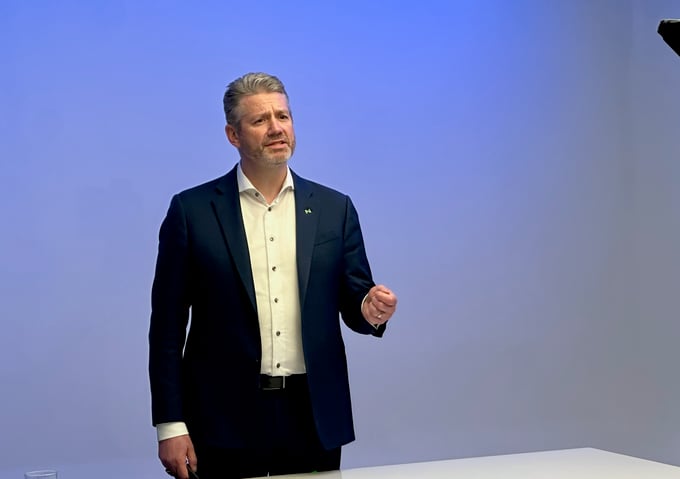 Arne Norheim, CEO of Azets Norway
As repetitive tasks are reduced, the human role evolves. Work becomes less about execution and more about judgment, interpretation, and decision-making. This shift raises expectations. People are now expected to think more, decide faster, and create more value in less time. At the same time, organizations are dealing with increasing complexity. According to Azets’ data, 63% of leaders say lack of skills is limiting their ability to grow, while 57% feel the weight of more complex regulatory requirements.
Arne’s message to leaders was clear: efficiency on its own is not enough. The real opportunity lies in how the time saved is used. If it simply leads to more output and higher expectations, the result is exhaustion. But if it creates space for better thinking, better decisions, and stronger value creation, then AI can become a true advantage.
Rahaf Harfoush: The Problem Started Before AI
Rahaf built on Arne’s perspective by stepping back and looking at the bigger picture. Her argument challenges a common assumption: the tension we feel at work today is not caused by AI alone. In many ways, it started long before.
“A lot of the productivity assumptions, the best practices, were pulled from the Industrial Revolution; they were made for assembly line work.”
Many organizations still operate with productivity models designed for a different type of work. These models were built for environments where output was visible, measurable, and linear. But modern work is very different. Today, much of what people do involves thinking, collaborating, solving problems, and creating new ideas. These are complex, cognitive tasks that do not always produce immediate or visible output.
This creates a fundamental mismatch. People are expected to deliver high-level thinking and creativity, yet they are measured using systems that reward constant activity and visible output. Over time, this disconnect creates pressure, because the way work is measured does not reflect how value is actually created.
When AI Amplifies the Wrong System
When AI is introduced into this environment, it doesn’t automatically solve the problem— but can actually make it worse. Instead of challenging outdated ways of working, organizations often use AI to reinforce them.
“You are now continuing to push those ideologies, and you're automating them as well.”
AI accelerates what already exists. If the system values speed and output above all else, AI will increase both. Work becomes faster, expectations rise, and the pressure intensifies. This is why many employees experience a growing sense of cognitive overload, even as tools become more advanced.
Rahaf encouraged leaders to rethink how they define efficiency. If efficiency is only about doing more in less time, it will always lead to higher demands. But if it includes the quality of thinking, creativity, and decision-making, then the outcome changes. Efficiency should not just be about speed. It should be about creating the conditions for better work. Rahaf Harfoush, digital anthropologist, bestselling author, and researcher
The Invisible Work That Drives Real Value
One of Rahaf’s most important insights is that much of today’s most valuable work is invisible. Activities like thinking through a complex problem, reflecting on strategy, or making sense of ambiguous information are essential, yet they are difficult to measure.
“If you sit at your desk and you're thinking about a really complex client problem, that's not being measured by emails being sent.”
Because these efforts are not easily tracked, they are often undervalued. This creates a culture where people feel the need to demonstrate productivity through constant activity, even when the real value comes from slowing down and thinking deeply. Over time, this leads to fragmented attention, reduced creativity, and ultimately lower-quality outcomes.
Recognizing and protecting this type of work is becoming one of the most important leadership responsibilities.
Designing Work for Human Performance
Rahaf’s message to leaders is not to resist technology, but to rethink how work is designed around it. The key question is whether organizations are optimizing for how humans perform at their best, or simply for how machines operate most efficiently.
Human performance is not linear. It depends on cycles of focus and recovery, periods of deep thinking, and the ability to step back and reflect. Yet many organizations still operate with an expectation of constant output, leaving little room for these essential elements.
So, leaders need to ask themselves different questions:
Are we creating space for focus, or are we rewarding constant responsiveness?
Are we allowing time for recovery, or are we filling every moment with tasks?
Are we measuring what truly creates value, or just what is easiest to track?
The answers to these questions shape not only performance, but also well-being and long-term sustainability.
Redefining Performance in the Age of AI
At the core of Rahaf’s perspective is the need to redefine what performance means in a modern organization. Instead of focusing only on output, leaders need to consider how value is actually created.
This includes elements that are harder to measure but critical for success, such as deep thinking, creativity, learning, and solid decision-making. These capabilities become even more important as AI takes over routine tasks.
Without this shift, organizations risk using powerful technology to accelerate the wrong behaviors. Instead of unlocking human potential, they create environments that drive burnout and disengagement.
From Efficiency to Sustainable Value Creation
Both Arne and Rahaf arrive at the same conclusion from different angles. AI is not the problem. The real challenge lies in how organizations choose to use it and how they design work around it.
If efficiency leads only to more volume and higher expectations, people will continue to feel exhausted. But if it creates space for better thinking, stronger collaboration, and more meaningful contributions, it can transform how organizations operate.
This is ultimately a leadership question. Leaders are now required to balance performance with sustainability, speed with reflection, and technology with humanity.
Key Takeaways:
- Efficiency is increasing, but so is the cognitive demand placed on people
- Many productivity systems are outdated and not suited for modern knowledge work
- AI can amplify existing problems if leaders do not rethink how work is designed
- The most valuable work today is often invisible and difficult to measure
- Sustainable performance requires time for focus, recovery, and deep thinking
- Leaders must design work environments that support human performance, not just machine efficiency
Questions to Consider:
- How are you currently defining efficiency in your organization?
- Are your performance metrics rewarding activity or real value creation?
- Do your teams have enough space for deep thinking and recovery?
- What types of invisible work might be overlooked in your organization?