Jesper Brodin is the former CEO and President of Ingka Group, the world's largest IKEA retailer, where he led one of the most significant transformations in modern retail.
When Jesper became CEO of IKEA in 2017, his job description looked straightforward: Lead one of the world's most recognizable brands. Grow the business. Continue its success.
What followed was something else entirely: Digital disruption. A global pandemic. War. Hyperinflation. The erosion of geopolitical cooperation. The growing urgency of climate change.
Over nearly nine years, Jesper led IKEA through two major transformations while navigating one crisis after another.
At Oslo Business Forum, he revealed the lessons the experience taught him and how, amid the relentless pressure to solve today's problems, leaders must have the courage and preserve the optimism to imagine a better future.
Don't Let Success Block Your View of the Future
IKEA was late to digital retail, and Jesper was candid about why.
Its stores were enormously popular, its business model was well established, and its culture and legacy were strengths. But this success made it easier for IKEA's leaders to believe the future would look like the past.
"There is this risk in that you start to run the car with bigger and bigger rearview mirrors and a small front window."
Jesper Brodin
After becoming CEO, Jesper embarked on a five-week global tour, visiting customers and coworkers across Europe, North America, and Asia. He had hundreds of conversations, but one in Tokyo finally crystallized the message.
A woman told Jesper that she loved IKEA and expected to continue visiting its stores. But on a Tuesday night, after putting her children to bed and finishing the dishes, she wanted to be able to buy from her phone. If IKEA wasn't there, she would buy from someone else.
Jesper returned to his management team and presented what he considered a travel report. One colleague saw something more: a new strategy.
Within weeks, IKEA had shared the new direction with hundreds of leaders and its board. The signal the company needed hadn't emerged from an elaborate strategic-planning exercise—it came from listening to customers.
Take the First Step Before You Have the Perfect Strategy
Recognizing the need to transform didn't make the transformation any easier. IKEA had decades of technology, logistics, distribution, and service infrastructure to untangle. Jesper described the work as "re-piping" the IKEA network.
Then the pandemic arrived. At the time, IKEA had a three-year plan to shift from a store-based to an omnichannel model. Suddenly, it had weeks.
The team responded, and within six weeks, IKEA had all of its markets operating online—not perfectly, Jesper said, but functioning. What had been planned as a multi-year transformation accelerated dramatically because circumstances made waiting impossible.
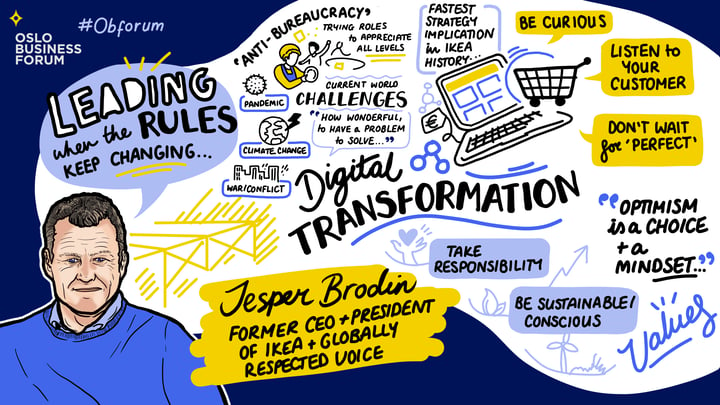
For Jesper, the experience reinforced a principle that became central to his leadership: "Take the first steps, don't aim for the perfect strategy, but most of all, listen to your customers."
The lesson for leaders? Transformation requires just enough clarity to know the direction and enough courage to begin.
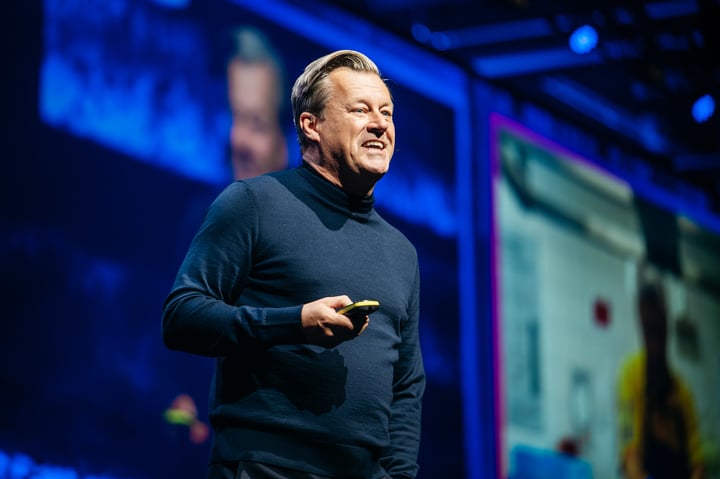
Jesper Brodin at Oslo Business Forum 2026
Transform the Business Model, Not Just the Product
IKEA's sustainability transformation began with a different kind of customer insight.
The company understood its responsibility. Its global footprint stretches from raw materials through manufacturing, transportation, and retail to the way customers use and eventually dispose of products.
IKEA knew consumers expected the company to act on climate change, but another finding created a challenge. When they asked customers whether they were willing to pay more for sustainable solutions, very few said yes.
The reason became tangible for Jesper during a conversation with a single mother in Serbia. She had two sons and limited financial flexibility. "Do you think I can afford to pay for this?" she asked him. That question changed IKEA's thinking.
Sustainability couldn't simply become a premium feature added on top of existing products. It had to become part of the business model itself. That meant finding ways to reduce environmental impact while preserving IKEA's fundamental promise of affordability.
The company invested in renewable energy, material innovation, more efficient production and transportation, and products that helped customers reduce energy and water consumption. It also worked to understand precisely where its impact occurred across its full value chain.
"If you want to play this game," Jesper said, "you need to get your facts and truly understand where your impact sits."
Turn Sustainability into Economic Strength
IKEA's experience ultimately challenged another assumption: that sustainability comes at the expense of financial performance.
Jesper said the company discovered that reducing carbon frequently reduced costs as well. "Every time we took a stab at carbon, we actually reduced our cost basis," he said.
Efficiency improvements lowered waste. Renewable energy reduced exposure to energy costs. Material innovation created new opportunities. And when the company later made a major investment in lowering prices for customers, Jesper said much of the funding came from savings generated through sustainability efforts.
Over the period he described, IKEA grew while simultaneously reducing its absolute carbon footprint. For Jesper, it became clear that sustainability could make the company more accessible to customers, more resilient, and financially stronger.
The transformation worked because sustainability wasn't treated as a parallel initiative competing with the business. Instead, it became a way to improve the business itself.
Organizations often approach major societal challenges by asking what they can afford to do without compromising performance. IKEA's experience suggests a more ambitious question: How might solving the problem strengthen the business model at the same time?
Let Values and Vision Become the Compass
Digital disruption and sustainability presented challenges for IKEA, but Jesper saw a common leadership reality underneath them.
Again and again, IKEA encountered situations for which there was no roadmap. In those moments, he learned that values and vision could provide what detailed plans could not. The company could ask whether a decision aligned with its purpose, values, and intended destination even when leaders didn't know what would happen next.
"If you have values and a vision as a compass, that will help you."
Jesper Brodin
A compass doesn't give you turn-by-turn instructions—it provides direction. That distinction allowed IKEA to move more quickly in situations where waiting for certainty would have slowed the organization down.
The coming years are unlikely to become less volatile, and organizations need more than a plan for working in stable conditions. They need clarity about who they are and where they're going to help them make decisions when the plan stops working.
Choose Optimism
Jesper doesn't expect the road ahead to be smooth, but he rejects the idea that leaders shouldn't feel optimistic.
"Optimism isn't something that comes to us if we wait. Optimism is a mindset. It is a choice that we make as we lead."
Jesper Brodin
When circumstances make optimism difficult, leaders often become consumed by immediate problems. There's always another crisis to manage, target to meet, or operational issue to solve. Jesper worries that an entire generation of leaders might someday look back and conclude they became exceptionally good at fixing problems.
"The world is not built by people managing problems," he said. "It's built by dreamers, people with a vision, people who see opportunities."
Dreaming might feel indulgent when you're carrying so much responsibility. But Jesper believes leaders must deliberately reserve time to imagine the future they want to create—for their organizations, for themselves, and for the world. Without that vision, leadership becomes an endless exercise in reacting to what already exists.
Make Time to Dream
Early in his tenure as CEO, Jesper spent time working inside an IKEA store as part of what the company calls an "anti-bureaucracy week." He washed dishes, talked with coworkers, and stayed close to the reality of the business.
At one point, a restaurant manager who didn't recognize him asked whether he was a manager. Jesper said yes. The employee asked if he reported to IKEA's Swedish country manager. When Jesper explained the reporting relationship actually worked the other way around, the man laughed, hugged him, and said, "Keep on dreaming."
Years later, the phrase feels almost prophetic. IKEA's transformation required practical decisions, major investments, and relentless execution. But Jesper's broader leadership message is that transformation begins with imagination.
The road ahead may be bumpy, but the future will be shaped by the people willing to board the train. The worst place to be, Jesper said, is standing at the station after it has already left.
Key Insights
Questions to Consider