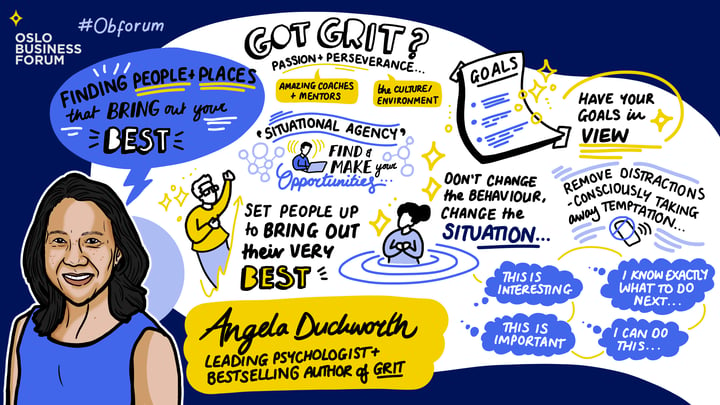
Angela Duckworth is a psychologist and bestselling author known for her research on non-IQ competencies, including self-control and grit, as predictors of success.
Angela has spent much of her career studying what the world's highest achievers have in common. Her best-known answer is grit: the passion and perseverance to pursue long-term goals with extraordinary consistency.
At Oslo Business Forum, Angela explained how she has widened her lens. Knowing that grit is the inside game of achievement, she became increasingly curious about the outside game: the environments, relationships, and cultures that allow individual effort to grow into exceptional performance.
World-class performers don't simply work hard. They tend to find themselves in situations that bring out their best. They have peers who challenge them, coaches and mentors who guide them, physical environments that reinforce their goals, and cultures that combine high expectations with meaningful support.
Sometimes they're fortunate enough to find those conditions around them—and sometimes they deliberately create them.
"When you change your situation, you change yourself."
Angela Duckworth
Change the Situation, Not Just the Person
When people fall short of a goal, Angela has found that they often reach the same conclusion: they failed because they lacked willpower.
The solution is usually to try harder, but Angela argues that focusing only on behavior is the least effective way to intervene. Instead, you should trace the behavior upstream.
Our thoughts influence our effort and actions, and the situations around us shape those thoughts. For high performers, Angela has identified four thoughts that help passion and perseverance come naturally:
Compare those thoughts with the internal dialogue of someone relying on willpower alone: I have to do this. I need to force myself to do this. I don't want to do this, but I will.
The better strategy is to create a situation that naturally produces the thoughts and behaviors associated with high performance.
For individuals, that means exercising situational agency: proactively changing the environment around you.
For leaders, it means practicing situational leadership: helping people find or create environments that bring out their best.
"You could argue that this is the entire job description of a great leader," Angela said, "Putting people in a 'sweet spot' where their potential can flourish."

Angela Duckworth at Oslo Business Forum 2026
Put Yourself in a Better Situation
French swimmer Léon Marchand offers a striking example of situational agency.
At the Tokyo Olympics, Marchand placed sixth in the 400-meter individual medley. He had a strong coach and trained in a supportive environment in Toulouse, but he wondered if his situation could be even better.
At 18, he emailed Bob Bowman, the longtime coach of Michael Phelps, about joining his team at Arizona State University. Marchand wanted to train alongside swimmers pursuing the highest levels of international competition and under a coach with an extraordinary record of developing elite athletes.
That email changed his situation. Within two years, Marchand had improved his best time in the 400 individual medley by more than eight seconds and broken the last remaining individual world record held by Michael Phelps. A year later, at the Paris Olympics, he won four individual gold medals and set an Olympic record in every event he entered.
Marchand still needed talent, discipline, and grit. But changing his environment changed what that effort could produce. Instead of asking, "How can I force myself to perform better? " he asked, "Where could I get better and who could help me?"
Start with the Space Around You
The most immediate part of our situation is the easiest part to change: our physical environment. Our personal space—roughly the three feet around us—is within reach and within view. That space can either reinforce our goals or compete with them.
As an 11-year-old, Michael Phelps wrote down his swimming goals and taped them beside his bed, making them the first things he saw each morning and the last things he saw at night.
The principle is simple: bring the things that support your goals closer and move the things that distract you farther away.
The most obvious example of this for many people is their phone. Angela shared research showing a relationship between students' academic performance and how far away they placed their phones while studying. The farther away the distraction, the better the performance.
"Physical distance from temptation creates psychological distance from temptation," she said.
The same thinking applies at work. Consider whether employees' environments make desired behaviors obvious and easy, or whether those environments constantly compete for their attention. Rather than expecting people to resist distractions through willpower, change the space around them.
Find Your Community
Our situations are both physical and social. A common characteristic Angela sees among high achievers is that they tend not to seek peers who are pursuing similarly ambitious goals.
Y Combinator offers one example. The startup accelerator deliberately funds founders in batches rather than individually, creating communities of people navigating similar challenges at the same time.
They believe that even if someone can do all the work alone, difficult pursuits benefit from a community in which you can brainstorm, challenge bad ideas, provide accountability, and offer encouragement when things go wrong.
For leaders, that means asking whether people have access to community. This may be especially important for younger employees, who increasingly default to working independently.
High performance may be individual, but the conditions that enable it are deeply social.
Every High Performer Needs Their Leader
Peers help us perform better alongside one another. Mentors offer something more: experience, perspective, and guidance from someone further along the path.
Angela's research has repeatedly shown the importance of coaches and mentors in high performers' lives. Even Anders Ericsson—the psychologist whose research on deliberate practice became associated with the "10,000-hour rule"—emphasized that high-quality practice requires a teacher, coach, or mentor who can identify mistakes, provide feedback, and suggest what to try next.
"Every high performer needs their leader."
Angela Duckworth
Mentorship can be difficult to create deliberately, but the relationship can emerge from a small interaction.
Oprah Winfrey's lifelong relationship with Maya Angelou began when a young Winfrey asked Angelou for an interview. She promised to take only five minutes, and she kept that promise. Her preparation and curiosity left a lasting impression.
Angela experienced something similar when Cody Coleman, then a graduate student at MIT, emailed her after seeing her TED Talk. Rather than asking Angela to mentor him, Coleman expressed interest in her work and offered to help with her research.
Their initial conversation led to a project. That project kept them in each other's orbit for weeks and months. Over time, the relationship deepened.
Angela encouraged leaders to normalize that progression inside organizations. Junior employees can learn to ask more experienced colleagues for advice. Leaders can make themselves available for those conversations. Shared projects can then turn brief interactions into longer developmental relationships.
Culture Is the Way
Personal space, peers, and mentors all sit within a larger environment: culture. Angela defines organizational culture as "the way we do things around here."
"Every organization has a why, but every organization needs a way. The way is your culture."
Angela Duckworth
A mission can articulate why an organization exists, but culture determines how people behave while pursuing it.
Angela's study of high-performance environments suggests that the strongest cultures combine two qualities that can sometimes be mistaken for a paradox: challenge and support.
She demonstrated how the two can work together using an example from Wegmans, a U.S. supermarket chain that has repeatedly appeared on lists of the best workplaces. One of the company's stated values emphasizes caring about the well-being of every person, while another emphasizes high standards.
So, people are supported. And much is expected of them.
This combination creates the conditions for sustainable high performance. Challenge without support can overwhelm people. Support without challenge fails to help them grow.
Create a Flywheel for Human Potential
Angela's inside and outside games ultimately reinforce one another:
Then the cycle begins again.
Cody Coleman described this flywheel in his own life. He was born while his mother was in prison and grew up in poverty while helping care for his grandmother. He eventually graduated from MIT and earned a PhD in computer science from Stanford, becoming only the third Black recipient of that degree in Stanford's history. He later became CEO of AI startup CoActive.
His situation improved with each chapter of his life, bringing new challenges, stronger support, and opportunities to learn from people around him. Progress opened the door to a better environment, which enabled even more progress.
This is the connection Angela makes between the work that defined the first half of her career and the questions driving the second: grit is still a powerful predictor of success, but performance compounds when people operate in a sweet spot.
Key Points
Questions to Consider