Shawn Kanungo is a leading speaker on innovation and AI who helps leaders understand what AI changes at the strategic level, and what it demands in practice.
At Oslo Business Forum, Shawn took leaders through a rapid-fire tour of generative AI, autonomous agents, and artificial general intelligence. He argued that technology has reached a point where leaders must stop asking how AI can make their organizations incrementally better and start asking what they would build if they could start again.
An Invitation to Reinvent
For years, organizations have been preparing for an AI-powered future. Shawn has news for them: the future is here.
AI can already perform tasks once reserved for highly trained professionals. Autonomous agents will increasingly navigate software, make decisions, and execute work on our behalf. Entire processes—and potentially entire jobs—will be redesigned.
But Shawn doesn't see that as something to fear. Instead, he sees it as an invitation to reinvent.
That means building organizations from zero instead of just automating what already exists. It means deciding which experiences should become seamless and where human friction becomes more valuable. It means caring deeply enough about customers to create experiences that technology alone can't replicate.
It also means recognizing that when everyone has access to extraordinarily capable technology, competitive advantage may come from something distinctly human: the courage to have a dangerously bold idea.
Build the V2
The first wave of generative AI gave millions of people a new set of tools. They polished emails, updated profiles, answered questions, and created improbable images.
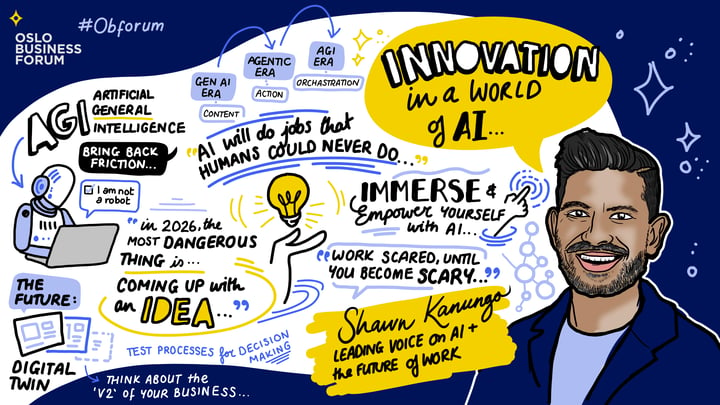
Shawn argued that leaders who still look at AI as a tool for individual productivity are already looking backward. The world is moving from the generative era to the agentic era and toward an era in which increasingly capable AI systems can reason, plan, and execute.
As a result, companies that have spent decades creating elegant user experiences for humans will instead find themselves designing for the agent experience: how easily AI can navigate and use their products and systems.
Headed into this era, Shawn believes every company should be building a parallel version of itself. It's an opportunity to build from zero around the capabilities that now exist.
"Every single company should be building a V2."
These "V2" digital representations can run experiments before implementing them in the real world, making it possible to test assumptions, redesign processes, and explore ideas at speed and scale.
Instead of asking where AI can be inserted into an existing process, imagine the process never existed. How would you design it today? What entirely new product, service, or experience could become possible?
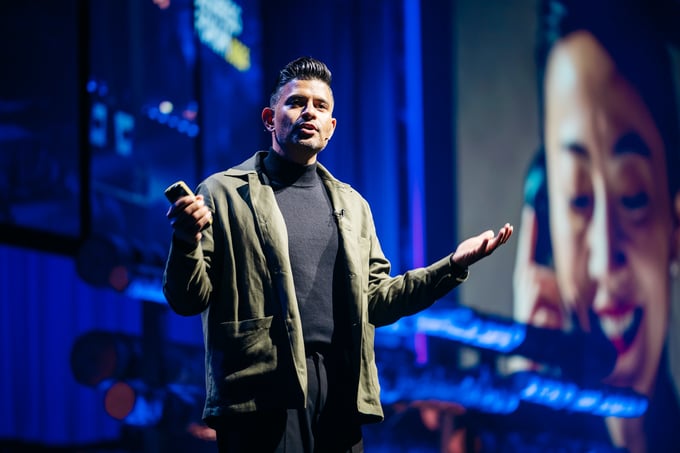
Shawn Kanungo: Leading authority on innovation and AI
Work Scared Until You Become Dangerous
Shawn is constantly asked, "Will AI take jobs?" His answer is clear: yes, autonomous agents will replace some work.
But he doesn't want fear to paralyze leaders. He wants them to respond with curiosity. If you feel intimidated by AI, immerse yourself in it. Ask: Now that we have this extraordinary technology, what more can we create?
"Work scared until you become scary. Work scared until you become dangerous."
The work of imagining how AI could reshape an organization can't be handed to an intern, an innovation team, or an outside consultant while senior leaders remain at a distance. They need firsthand experience to develop judgment about what becomes possible.
Choose Your Edge
If AI can radically transform what organizations do, Shawn believes leaders need to ask another question: What will not change?
One answer is our desire for convenience. People have always gravitated toward products and services that make life easier, and AI agents will keep accelerating that expectation.
Shawn believes companies should race toward that edge. Make the experience extraordinarily fast, easy, invisible, and seamless. But there's another edge, too: the human edge.
As digital experiences become increasingly automated, friction itself becomes valuable when it's deliberately human. Shawn pointed to experiences that are tangible, beautiful, personal, or memorable precisely because they require time and human attention.
Shawn warned, however, that there's a balance between efficient and attentive. Companies that are neither amazingly seamless nor meaningfully human risk disappearing into what he described as the "black hole of mediocrity."
The strategic choice leaders need to make is deciding which friction deserves to disappear and which friction creates meaning. The technology itself can't make that decision for you.
Have a Dangerous Idea
We know that AI can surface, analyze, and synthesize enormous amounts of information. But Shawn sees a limitation inside that capability: AI is built from what already exists, and what already exists eventually becomes conventional wisdom.
When conventional wisdom is increasingly abundant, every organization draws from the same information, generates the same analyses, and applies the same practices. In that environment, differentiation disappears.
When differentiation disappears, the solution is to have a dangerous idea.
"AI will never be able to come up with a dangerous idea. And the world was built on dangerous ideas."
Dangerous ideas challenge what everyone believes. They start with asking a different question, identifying an opportunity that others have dismissed, or pursuing an idea that evidence doesn't yet support. They also usually seem impractical—or even foolish—at first.
"Dangerous ideas look dumb," Shawn said. "Until refusing to consider them makes you look dumb."
Become a Rookie Again
So, how do experienced leaders become capable of dangerous ideas? Shawn's answer is to become a rookie.
Take one process inside the organization and ask yourself: If I were starting from zero today, what would I do?
What would you automate? What would you eliminate? Where would you deliberately introduce more friction? Where would you add more humanity?
Starting from zero can reveal possibilities that incremental improvement would never expose. But this method requires leaders to confront an uncomfortable truth: experience can sometimes be baggage.
The practices that produced success in the past become deeply embedded in organizations. Eventually, leaders stop seeing them as choices and start seeing them as reality. That's when disruption becomes difficult, and stagnation becomes a threat.
Shawn's challenge is to stop letting the past dictate the future. "Thank the version of yourself that got you here," he said. "Then bury it."
Disrupt Something
Business conferences often produce their own kind of illusion. People gather in a room, hear provocative ideas, go home and tell their spouses about an interesting speaker. Then Monday arrives and the familiar routine resumes.
Shawn challenged leaders at OBF not to let that happen. Instead, take one process, one experience, or one assumption and start from zero. Have the courage to pursue a dangerous idea.
The human edge belongs to those willing to imagine what hasn't yet become obvious.
Key Points
- Build a V2 of your company. Rather than inserting AI into existing processes, ask how the organization would operate if today's tech had existed from the start.
- Develop firsthand AI fluency. Leaders can't outsource their understanding of AI. Experiment to build the judgment required to lead through it.
- Choose where friction belongs. Some experiences should become radically seamless; others should preserve meaningful human interaction. Resist working in the undifferentiated middle.
- Pursue dangerous ideas. AI is extraordinarily capable of analyzing what already exists. The human edge comes from imagining what doesn't yet exist.
Questions to Consider
- If you were to rebuild one part of your organization from zero today, what would you automate, eliminate, or make more human?
- Where is your customer experience currently stuck between being truly seamless and being meaningfully human?
- Which assumption has your experience taught you to accept that a rookie might be willing to challenge?