Anu Bradford is a professor of law and international organization at Columbia University and has become a leading voice on how power is exercised through rules rather than force.
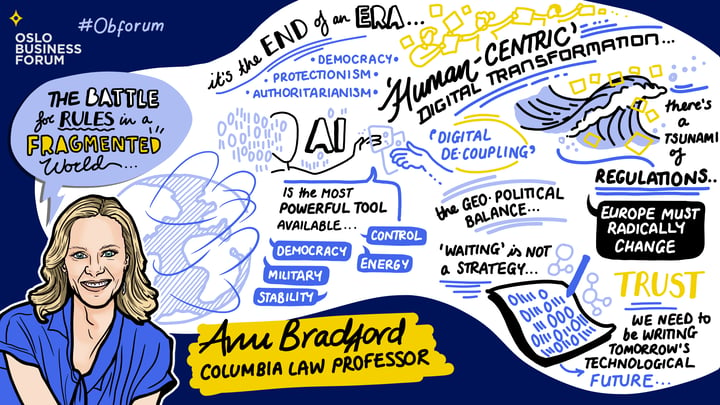
At Oslo Business Forum, Anu argued that the AI race is a contest over what kind of technological future societies want to create. And Europe has an opportunity to strengthen its capabilities while preserving a distinctly human-centric approach.
Three Models for Governing Technology
Artificial intelligence is advancing as the global order is being rewritten. Geopolitical tensions are rising. Economic openness is giving way to nationalism. Democratic institutions are under pressure. The relationship between the United States and Europe has become less predictable.
Against that backdrop, AI isn't just another technological transformation, but a source of economic, geopolitical, and military power.
"It is a race for technological supremacy, but also economic supremacy, geopolitical, and even military supremacy."

Anu Bradford: Columbia Law Professor and world-leading expert on global regulation and digital power
Anu described three broad approaches to governing technology:
1. The market-driven American model. This model emphasizes free markets, free speech, incentives to innovate, and limited government intervention. Technology companies play a central role in shaping how digital systems evolve, with a heavy focus on maximizing technological opportunity.
2. The state-driven Chinese model. China also seeks technological leadership, but the government uses technology as an instrument of surveillance, censorship, propaganda, and political control.
3. The rights-driven European model. Europe has attempted to place individuals and democratic institutions at the center of technological transformation. Regulation is used to protect fundamental rights, preserve democratic structures, and shift some power away from dominant technology companies.
"The American model for the Europeans is simply too permissive, while the Chinese model is too oppressive."
Anu rejects the assumption that Europe must surrender its current model and choose between the American and Chinese alternatives. Europe needs its own path, but that path will require the technological and economic capacity to make meaningful choices about its future.
Recognize That Technology Is Now Geopolitics
The three models Anu described are increasingly colliding. The U.S. and China are competing directly for AI leadership, creating pressure on both countries to accelerate rather than slow down. If one imposes guardrails, it fears the other will race ahead.
Meanwhile, tensions have also increased between the U.S. and Europe as Europe has sought to regulate dominant American technology companies over concerns including competition, personal data, and harmful content. American companies—and increasingly the U.S. government—have pushed back, characterizing European rules as overreach that disproportionately targets American businesses.
Technology regulation has consequently become intertwined with trade and geopolitics. For Europe, that creates a deeper vulnerability.
Its dependence on the U.S. is not primarily about trade, but about security and technology. That dependence limits Europe's ability to make policy choices independently when disagreements arise.
Anu therefore sees strategic autonomy and technological sovereignty as increasingly important. Europe must strengthen its ability to defend its security, prosperity, democratic institutions, and technological future.
Build the Capacity to Choose
Anu encouraged Europe to strengthen partnerships with other democracies, including Canada, Japan, South Korea, and Australia. But she noted that partnership is different from dependence.
A sovereign Europe needs enough technological capability to avoid having essential infrastructure, platforms, and AI systems controlled entirely elsewhere.
Today, American companies dominate the ranks of the world's largest technology firms and hold an enormous advantage in the computing infrastructure that supports AI. Meanwhile, Europe's strength lies in regulation.
Anu acknowledged the imbalance bluntly: Europe has become very good at adding the legal layer to the technology stack. But regulation alone is not enough.
Europe fell behind during the internet revolution as American technology companies captured much of the economic value created by that transformation. The rise of AI presents another critical moment, and Europe can't afford to repeat the pattern.
Don't Confuse Deregulation with Innovation
Europe's competitive gap has produced an increasingly popular diagnosis: regulation is the problem.
But Anu rejects the conclusion that removing the rules will allow innovation to follow. In fact, clear rules provide something innovation needs: trust and certainty.
"Europe has a problem, but deregulating is not our path to victory."
People must trust technology for it to achieve widespread adoption. Businesses also need predictable rules if they're going to make long-term investments.
Anu pointed to growing public concern about AI in the U.S.—from safety and jobs to energy costs and children's mental health—as evidence that the absence of guardrails doesn't automatically produce public confidence.
The goal shouldn't be to choose between innovation and regulation. It should be to create the conditions in which regulation supports trust while other reforms address the actual barriers preventing European technology companies from scaling.
Fix the Foundations of the Technology Ecosystem
If regulation isn't the primary obstacle, what is? Anu identified several structural weaknesses.
Create a true digital single market. Europe may contain 450 million consumers, but technology companies still face different national laws, languages, and market conditions as they attempt to expand across the continent. A more integrated digital market would allow European companies to grow across borders more easily.
Build integrated capital markets. European startups can often secure early-stage financing but face difficulty when they need more capital to scale. At that point, they turn to American venture capital or are acquired by American companies—effectively becoming part of the U.S. ecosystem. Too little of Europe's wealth is channeled toward scaling European technology companies.
Make room for failure. Anu argued that European insolvency laws and cultural attitudes toward failure can make experimentation unusually costly. Entrepreneurs who fail may struggle to raise capital again, and that encourages caution precisely where technological innovation requires risk.
Compete for global talent. The U.S. has long benefited from attracting ambitious people from around the world. Europe's ability to compete in AI will similarly depend on its capacity to attract, develop, and retain global talent.
Taken together, these factors lead to a different diagnosis of Europe's problem: the continent doesn't need fewer rules but a stronger ecosystem for turning ideas into companies that can scale.
Turn a Moment of Uncertainty into a Sputnik Moment
Anu described the current period as a potential Sputnik moment for Europe.
The original Sputnik launch shocked the U.S. into recognizing the risk of falling behind technologically and helped catalyze major investments in science, research, and education.
Europe now faces its own moment of reckoning: Dependence has become more visible. The competitiveness gap is clearer. The geopolitical environment is less forgiving.
But Anu sees the disruption as an opportunity "to see further, to think deeper, to act bolder."
She stressed that Europe can't achieve technological sovereignty through policy alone. Its companies must help build it. The continent's technological future will be shaped by the decisions business leaders make every day.
Decide Which Race You Want to Win
Europe must ask a fundamental question: What are we racing toward?
"The race I want us to win is the race that we are ambitious of harnessing all the tremendous opportunities that AI brings about for the benefit of our citizens," Anu said.
Technological leadership isn't meaningful because a model is larger, faster, or more powerful. The real test is what the technology enables people and societies to become.
Europe can become technologically competitive without abandoning the values it's trying to protect. By creating the conditions for European companies to innovate, scale, and compete, we can shape an AI revolution that ultimately serves people.
Key Points
- AI leadership is geopolitical leadership. The AI race will influence technological, economic, military, and political power.
- Strategic autonomy requires technological capability. Europe cannot make independent choices about its digital future if it remains dependent on foreign technology and infrastructure.
- We must strengthen the innovation ecosystem. A digital single market, integrated capital markets, greater tolerance for entrepreneurial failure, and access to global talent are critical to European competitiveness.
- Companies can help shape Europe's technological future. The continent's response will be shaped in part by investment, hiring, innovation, and strategic decisions made inside businesses.
- Define success before joining the race. Technological progress should ultimately be judged by whether it creates meaningful benefits for people and societies.
Questions to Consider
- Where does your organization depend on technologies, platforms, or infrastructure over which it has little control?
- Are your organization's rules creating unnecessary friction that prevents people from adopting new technology confidently?
- Before accelerating your AI investments, have you clearly defined what you're racing toward and who should ultimately benefit?