Terrence Mauri is one of the world’s leading thinkers on leadership, AI, and disruption. Known for challenging leaders to unlearn old rules and embrace change with courage, he has advised organizations across industries on how to thrive in the future. At Oslo Business Forum, Terrence delivered what he called a “double espresso” for leaders. A jolt to spark thinking, ignite new perspectives, and push past the bureaucratic misery index.
Panic vs. Complacency
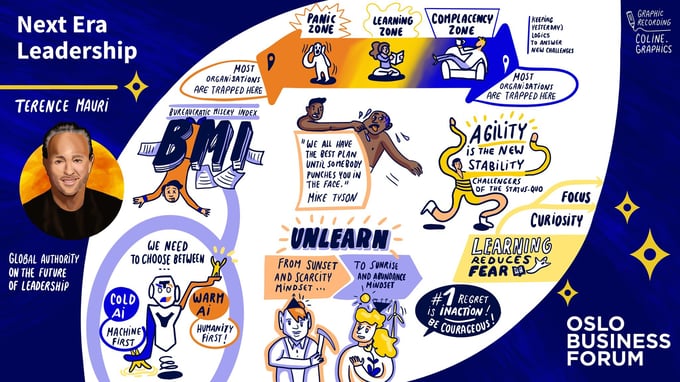
According to Terrence, most companies today are stuck in one of two “deadly zones.” In the panic zone, urgency outpaces readiness. In the complacency zone, overconfidence outweighs humility. Both are dangerous.
The real choice for leaders is to leave those zones behind and step into one where technology and heart work together. “The biggest risk you can take right now is thinking too small,” he cautioned.
"The biggest risk you can take is thinking too small."
.jpg?width=680&height=453&name=54823646727_e9d35ffd8d_k%20(1).jpg)
Terence Mauri: Global authority on the future of leadership at Oslo Business Forum 2025
Complexity vs. Simplicity
Today’s volatile environment has created what Terrence calls a wisdom gap: rising complexity coupled with falling capacity to respond. The result is slower, less agile organizations at a time when speed matters most.
An inability to adapt is especially dangerous at a time when most leaders have reported that they expect even greater industry disruption and talent scarcity in the next 12 months. Yet, only a few say they are prepared for the shifts to come.
“Agility is the new stability,” he argued, citing Mike Tyson’s famous line: “Everyone has a plan until they get punched in the mouth.” Companies with rigid strategies will stumble; those that pivot quickly will thrive.
Cold AI vs. Warm AI
Terrence urged leaders to distinguish between what he terms “cold AI” and “warm AI.” Cold AI is machine-driven, efficient but dehumanizing. Warm AI, by contrast, is human-centered, empowering people and elevating humanity.
“We have to avoid artificial idiocy and artificial leadership,” he said. “The future isn’t just about technology and chance. It’s about mindsets and choices.”
Terrence asked leaders to imagine a new, cognitive-enabled organization—one that doesn’t hesitate or ask for permission but seizes opportunity.
The New Logic of Competition
Competition today is no longer just about products or price. It’s about culture, adaptability, and the ability to unlearn. Terrence spotlighted Lidl, a legacy-driven, 100-year-old organization that pivoted to the future.
Lidl doubled down on digital cybersecurity when customers demanded alternatives to U.S. and Chinese providers. Leaders of the company developed a billion-dollar belief—a clear-eyed, strategic conviction—in this idea. As a result, the new division now generates $1.9 billion annually and employs 300,000 people.
“You can’t guarantee the future; you have to renew your lease,” said Terrence. “You do that by pivoting to become a challenger of the status quo.”
Today Bees and Tomorrow Bees
Terrence encouraged leaders to take inspiration from an unlikely source: nature.
Nature offers a model for balance. In a beehive, 70% of bees focus on producing honey for today, while 30% scout for food sources for tomorrow. Leaders, too, must split their focus: execute for today while transforming for the future.
The most flexible, most future-focused leaders will thrive.
“The future of leadership is no longer the survival of the fittest but the survival of the fastest,” Terrence said. This means that the most flexible and future-focused leaders are the ones who will thrive.
Where to Go From Here: The Sunrise to Sunset Strategy
Terrence left leaders with a powerful call to action: activate the “Sunset to Sunrise Strategy.”
He called on leaders to sunset what no longer serves: bureaucratic work, outdated supply chains, zombie leadership, and even cold AI. In its place, sunrise new approaches: frontier leadership, mass intelligence, meaningful work, and warm AI.
The greatest threat isn’t disruption, he warned. It’s hesitation. Too many companies have the wrong KPIs in place, valuing bureaucratic behaviors over value-creating behaviors. His advice: “Don’t be afraid to go first,” he said. “Instead of calling it risk, call it R&D. Risk is an opportunity to be seized—it’s the upside of disruption.”
"Don’t be afraid to go first."
Ultimately, Terrence asserts that our biggest regret will be inaction. Leadership is never finished, and neither is strategy, culture, or values.
As Marie Curie once said, “Nothing in life is to be feared, it is only to be understood. Now is the time to understand more, so that we may fear less.”
Key Points
- Agility is the new stability. Complexity is rising, but leaders must simplify, pivot, and act fast.
- The biggest risk is thinking too small. Panic and complacency are equally dangerous zones.
- Warm AI empowers humans. Cold AI is machine-based and downgrades humanity. Warm AI elevates it.
- Unlearn and reimagine. Today, true competition happens in adaptability, culture, and the ability to unlearn.
- Balance today and tomorrow. As leaders, we must focus on performing and executing for today’s world, while also transforming for tomorrow’s world.
- Risk is the upside of disruption. Measured risk-taking fuels growth and transformation.
Questions to Consider
- Are you operating in the panic zone, the complacency zone, or creating a new one?
- Is your AI narrative “cold” (machines first) or “warm” (humanity first)?
- What billion-dollar beliefs will guide your organization into the future?
- How are you balancing today’s execution with tomorrow’s transformation?
Join Oslo Business Forum 2026: The Human Edge now! The Human Edge is about unlocking the strengths that no machine can replicate: creativity, courage, trust, and resilience to thrive. Don't get left out - join Northern Europe's greatest leadership happening today!
.webp?width=680&height=680&name=obf_2026_cta_banner%20(1).webp)